Harry Hicken
Harry Hicken was born on 6th November 1911 at 57 Rupert Street in Pilsley, Derbyshire, the eldest of four boys (Harry, Jack, Philip & Ralph) born to his father Henry and his mother Edna Elizabeth Hicken (née Spetch).
Henry, a leading figure in the Derbyshire coal mining community, was a methodist liberal who became a communist atheist and Harry, with his brothers, was brought up with socialist principles which remained foundational throughout his life.
Harry attended Netherthorpe Grammar School in Staveley near Chesterfield and then art school before joining the Royal Academy School of Painting in December 1931 at the same time as his lifelong friend William Scott R.A.,
In the Summer of 1934, by this time married to Rose Elizabeth Proudfoot and expecting their first child (Michael was born in May 1935) Harry graduated the Royal Academy and moved with Rose to Cambridge. It was while he was teaching in Cambridge that WIlliam Carter, founder of the Rampant Lions Press, introduced himself to Harry and began an association which resulted in the inaugral publication of the press. The Song of Solomon, with rubrication and printing by Will Carter, was illustrated by Harry with fine wood-cuts and remains, to our knowledge, the only publication containing Harry’s work. (We would very much enjoy being proved wrong in this respect). Collation of the images from the original of this publication are in progress and this site will be updated when they are completed.
Harry & Rose separated and were divorced in 1939 and Harry left Cambridge to live and work at the Derbyshire Miner’s Holiday Camp in Skegness before returning to Chesterfield where he lived for a while with his parents. He later met Agnes Cashmore and they married in July 1940, living first in Worksop where, in November 1947, their son Adrian was born and then moving to Newark in July 1950. They lived in the same house in Newark for the remainder of their lives together until Agnes passed in 1980. Harry remained in their home until his death in December 2000.
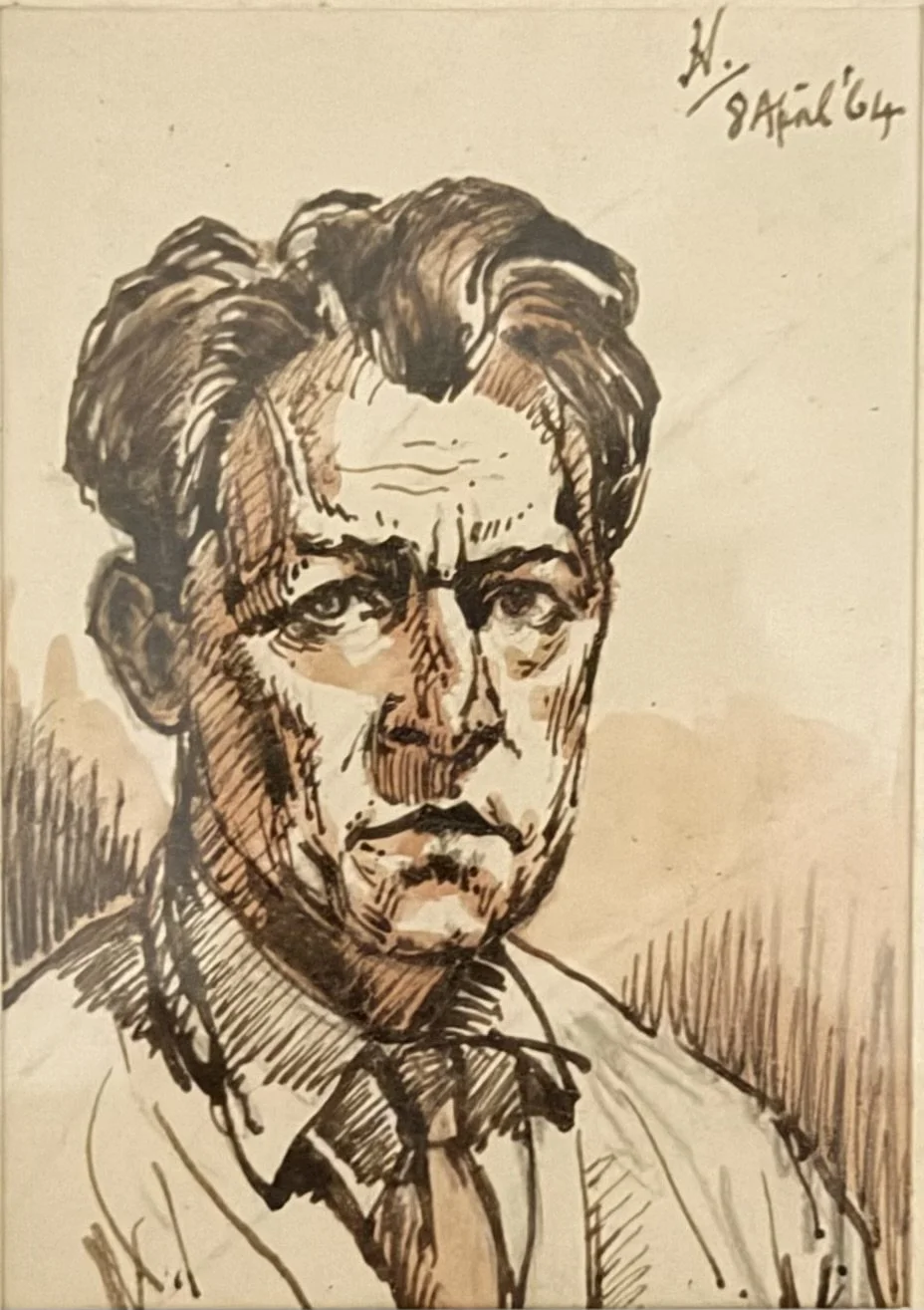
Throughout his teaching life and in retirement, Harry continued to paint and draw and infrequently to sculpt. His landscape works focussed mostly on locations close to Newark and in the Counties of Nottinghamshire, Derbyshire, Lincolnshire and Yorkshire. Portraiture was an enduring interest for Harry and also, we believe, a source of occasional income from commissions.
While we have featured on this site and in the gallery, images of Harry’s work to which we have access, we are also aware of many pieces which are referenced in correspondence and in articles, that were not in the physical collection to which we have access. If visitors to this site are aware of additional works and/or have images of those works, we would be delighted to hear from you and to be able to add to the completeness of this collation.
Let us know
If you have feedback on or input to any of the content curated on this site please let us know your thoughts using this form.